Passport to the Shredder, or On the Other Side of Bureaucracy: A Workshop on Generative Poetry by Ivan Netkachev
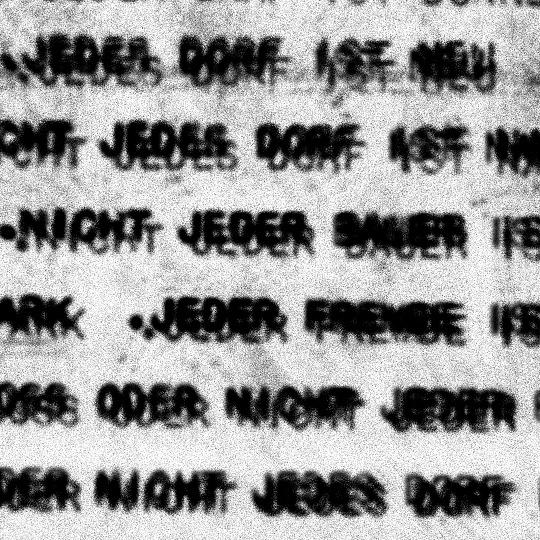
In this workshop about generative poetry, multimedia artist Ivan Netkachev will look at the role of violence in the language of bureaucracy. In the lecture part, the artist will discuss generative poetry in the history of art and literature. He will then suggest that participants work with a poetic text using the code of simple poetic algorithms in Python.
According to the anthropologist David Graeber, the language of bureaucracy is the language of violence. Bureaucratic violence is expressed through nonsensical language structures: the sense of what is said is lost in endless repetition and conglomeration (both grammatical and semantic). On the other hand, as queer theorist Paul B. Preciado writes, documents separate the visible from the invisible, the significant from the insignificant, the human from the inhuman. Documents humanize, but they also dehumanize: they separate citizens worthy of life and freedom from non-citizens, subalterns without citizenship or homeland.
The life of a citizen in a contemporary state is impossible without documents: bureaucratic violence is at the heart of the everyday. This is also reflected in language, in meaningless expressions and newspeak (Kornei Chukovsky’s kantselyarit). The imagination, to use Graeber’s words, is colonized by the language of bureaucracy. Living language is fettered by the format of announcements, formulas, and apostilles, otherwise state organizations pay no attention to the citizen’s request.
A possible means of decolonizing the citizen’s imagination is by learning the language of poetry as a counterbalance to the language of bureaucracy. Poetry can make something living from the non-living through the appropriation and collaging of nonsense language structures.
The artist can enlist chance as an ally: making friends with a combinatory machine that breaks up text and collages it, creating breaches in regulations and identity documents, grammatical glitches and mismatches. Linguistic scraps are an unexpected, previously unlocatable space of freedom. This is how Theo Lutz’s Stochastische Texte works: Franz Kafka’s The Castle is cut into small pieces and endlessly collaged.
The workshop will be in two parts. In the theoretical part, participants will look at the story of generative poetry, revealing its artistic qualities through the connection with surrealist collage and, through it, with chance, the unconscious, and left-wing movements in Europe between the two world wars. In the second part, they will consider real instruments for creating automatic verses—simple algorithms in Python and Markov chains. The Markov chain is one of the simplest self-learning algorithms. It is a mathematical system in which transitions from one state to another take place based on rules of probability. The source material will be real documents that will be transformed into a poetic text.
This event is part of the public program of theWorld Gone By computer class.
To take part
The workshop will take place via Zoom.
Free with advance registration.
Additional software will be required for use during the workshop. Installation instructions will be dispatched separately.
Registration
Authors
Ivan Netkachev
(b. 1998, Orenburg) is a multimedia artist, publicist, and writer. He has bachelor’s and master’s degrees in theoretical linguistics from the Higher School of Economics and is studying at Rodchenko Art School (Moscow). He works with automatic generation of texts and images, video games, and video. He writes for the journal Nozh and is the author of the Telegram channel beyond meaning. He lives and works in Moscow.